AI as a Creative Partner: Can AI Empower Sound Designers?
Interview with the creator of an AI-based software for sound library searches
Text: Elettra Bargiacchi *Interview Partner: Marc Specter Pictures**: Enos Desjardins
Text: Elettra Bargiacchi *Interview Partner: Marc Specter Pictures**: Enos Desjardins

Artificial intelligence has entered nearly every corner of the creative industries, and sound design is no exception. Yet many professionals view AI with unease, fearing that algorithms might one day replace the human ear, intuition, and craft that define their work. But what if AI could instead amplify creativity?
Looking closely at a sound designer’s workflow reveals how much of the job involves data management. A single project may require navigating terabytes of audio assets – drones, engines, ambiences, foley takes, and more. Searching for the right sound often depends on filenames and metadata, which are rarely consistent. As a result, this task can consume more time than the creative act itself. This inefficiency became the seed for the research that Marc Specter and his team pursued over the past year.
Marc Specter, an Emmy and BAFTA award-winning dialogue editor and creator of a popular dialogue editor toolkit, has now turned his attention to sound designers. His latest project is an AI-based software designed to make working with audio libraries easier and more intuitive. The basic idea: instead of generating sounds, the software listens. It analyses the sound library and finds matches based on tonal similarities. This approach goes beyond traditional metadata or filename-based searches, reducing dependence on how well sounds are labelled. For sound designers managing large and heterogeneous libraries, this means less time spent on searching – and more on making creative choices.
Marc: We developed a sound-searching library tool that uses AI to listen to your sound library and lets you search by sonic similarity and by meaning. You can ask it to find a sound like X, Y, Z – or even “a magical angel”. It digs into the deep, dark recesses of your library, surfacing material you might never have found because of poor or missing labelling. It opens the doors to your library in a way that nothing else does.

Marc: Matching by sound is a powerful tool, very fun and useful. You can record your voice or any sound: claps, smashing objects, whatever you like, and search for that performance. You can similarly filter the results – for example: find wind sounds similar to another wind and sort them according to their degree of distortion.
Marc: Any process that speeds up workflows is, by definition, moving toward replacing people – you’re making the job easier until one day it’s so easy that you don’t even need a real assistant anymore. It’s unavoidable. If you step off that path, you’re saying we should stop creating new tools. That’s how the world looks today: if you’re not utilizing an AI model, you’re probably falling behind.
But I see our software as an instrument to assist creatives. I don’t want to contribute to replacing people – that’s why I don’t want to bring generative AI into it, even though everyone talks about it as the next big thing. My intention, spiritually and practically, has always been to create a tool for people.
Early testers say that the new software reveals connections they would never have discovered manually. These “happy accidents” demonstrate AI’s potential as a creative catalyst rather than a mechanical assistant: the machine doesn’t decide for you, it simply opens doors. The result is not less authorship, but more surprise.
Marc: We have a chat called “Successes” where people post cool stuff. For example, someone was looking for relaxing effects and found a sound called “blowing dandelion seeds” – he’d never have searched a sound using this particular tag. Another user needed the sound of big lights being turned on, and came up with a basketball hitting a rim. Poof, it worked. One tester designed an old-school cash register using tram recordings. Another one needed the sound of an animated tiger landing in a bath and ended up with a gas cap flap closing. You would never think of typing in “gas flap”, but it took five minutes and worked out all fine.
Marc: We thought about that a lot. Our algorithm helps with both: It can provide random inspiration or help with precise curation, depending on how specific your search entry is. Using vague terms like “magical galaxy” or “angry cardboard box” will produce unexpected results and weird inspirations. Typing something specific, like “dog”, returns dog-like sounds, such as dog barking. The user can approach it any way they like, and that’s the beauty of it.
The conversation around AI in audio often focuses on efficiency or threat. The real risk is not machines stealing jobs, but that we stop engaging critically with the tools we use. Marc Specter shows that technology can respect human intuition while extending its reach, inspiring a different narrative: collaboration.
Tools like the described new software suggest a future where machines handle the heavy lifting while humans focus on storytelling, emotion and aesthetics. AI won’t erase the artistry of sound; it will redefine its boundaries. The question is no longer whether AI will replace us, but how boldly we choose to collaborate with it. In the hands of curious designers, tools as the one discussed don’t end creativity – they empower it.
→ Das Referat Forschung & Entwicklung arbeitet prinzipbedingt ganz vorne am Puls der Zeit mit. Welche neuen Trends gibt es? Welche Forschungen befördern echte Innovationen in unserer Branche, welche Produktvorstellungen sind wegweisend?
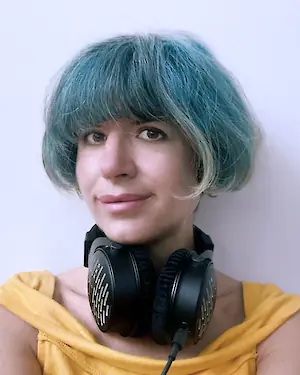
Elettra Bargiacchi is an Italian sound designer and composer based in Leipzig. With a background in classical guitar, composition, and Audio Post Production (Abbey Road Institute, London), her work in audio post spans Germany, Italy, the UK, and the US. Passionate about immersive audio and innovation in sound, she has been a Visiting Researcher at the University of Surrey (UK) since 2024, focusing on next-generation audio. She is a member of the VDT R & D Board.

Marc Specter is an Emmy and BAFTA-winning dialogue editor and software developer based in London. Trained in music, he began in audio post-production with audio post facility sound disposition and has since worked on numerous high-profile projects. As a programmer, he is the creator of Kraken Dialogue Editor Toolkit, and Orion, an AI-based tool designed to help sound designers manage and explore audio libraries more efficiently.