Why your own voice sounds weird on playback
Wave Field Synthesis and the limits of physical sound.
Text: Elettra Bargiacchi Interview Partner: Jens Ahrens Images: Jens Ahrens, ETI Detmold
Text: Elettra Bargiacchi Interview Partner: Jens Ahrens Images: Jens Ahrens, ETI Detmold
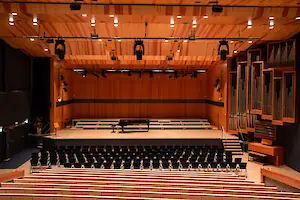
My fascination with Wave Field Synthesis dates back to last summer, when I visited Malte Kob, Head of our VDT R&D Department, and Professor at the Erich-Thienhaus-Institut of the Hochschule für Musik Detmold.
There, I had the privilege of listening to a demo of their Wave Field Synthesis system — more than 300 loudspeakers installed in the walls and ceiling of their concert hall. It was magic, not science: sound sources materialised beside me with impressive realism. I was literally inside a sonic world, having the most immersive experience ever. To explore this further I had the pleasure of interviewing Jens Ahrens — researcher, author of Analytic Methods of Sound Field Synthesis, and one of the leading figures in the field. This article aims to open the door to a broader discussion on spatial audio, a topic the VDT R&D Department intends to explore with a series of webinars.
One of the hardest concepts to communicate to those not being involved in the acoustics field is the difference between the physical and psychoacoustic approaches to sound reproduction. In order to clarify that distinction, Ahrens starts explaining stereo, something we all know:
J. A.: “Stereo works. You record a sound scene, play it back through two loudspeakers, and it sounds fairly similar to the original. But if you analyse the physical structure of the sound field produced by those two speakers, you’ll find out that it’s fundamentally different from what the microphones had recorded. And yet, our auditory system manages, through complex cognitive processes, to build a coherent perception from a physically absurd sound field.
The sound field is the complete physical description of how sound occupies a space, how it actually behaves. If sound were light, the sound field would be the lighting of a room — not just the source, but everything the light touches, how it spreads, reflects, where it casts shadows. Stereo does not recreate the original sound field. It makes our ears and brain believe it does.”
E. B.: “So stereo is an illusion that convinces the ears, but physically doesn’t correspond to anyhing real.”
J. A.: “Exactly. And the fascinating thing is that, even after almost a hundred years of listening to stereo sound reproduction, we still cannot fully explain why it works. The auditory system does something extraordinary: it identifies the two loudspeakers as separate sources and then, at a higher cognitive level, constructs a meaningful perception. It is magic, from a physical point of view.
This is the philosophy of the psychoacoustic approach: exploiting the mechanisms of human perception to create the illusion of space. Stereo, Dolby Atmos, Sony 360, VBAP — among the most widespread spatial audio technologies today — all belong to this family. WFS takes the opposite philosophy: rather than building an illusion, it seeks to physically recreate real sound waves, the ones that would exist if the sound source were truly there in space.”
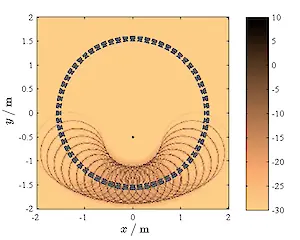
WFS uses arrays of dozens (even hundreds) of loudspeakers arranged around the listening area. Each is driven with a calculated signal, so that the superposition of all individual sound fields reconstructs a physically correct wavefront (see pic. 2). Unlike stereo or Atmos, which work well only at a specific point in the room (the sweet spot), WFS produces accurate spatial perception throughout the entire listening area.
Among its most astonishing possibilities are the so-called focused sources: virtual sound sources perceived as existing within the physical space of the room itself. “Especially the focused sources — they are certainly mind-blowing,” Ahrens admits. And that is precisely what I had experienced in Detmold: sound sources that seem to exist in the middle of the space with absolute realism, like sonic holograms.
Yet, WFS has one insurmountable physical limitation: spatial aliasing. Due to the distance between loudspeakers, above a certain frequency (around 1500–2000 Hz, depending on that distance) the synthesized sound field is no longer physically accurate. So why does it still sound good?
J. A.: “Most natural sounds — speech, musical instruments — concentrate their energy in the lower frequencies. The auditory system simply does not notice the inaccuracy in the higher frequencies.”
WFS takes shape in the 1980s thanks to A. Berkhout, who transfers the mathematical principles of seismic waves to the acoustic domain. Between the late 1990s and early 2000s, WFS experiences its moment of greatest commercial ambition, with companies in Germany and Switzerland being convinced the technology could conquer cinemas and large venues. Rumour has it that Michael Jackson himself was interested in WFS, to become the first artist in the world to use it live in stadium tours.
Anyway, the enthusiasm faded quickly: spatial aliasing, the enormous costs, and the absence of an accessible creative infrastructure for composers and sound designers, led to a progressive slowdown.
When Ahrens begins his PhD around 2006, WFS and Ambisonics are still two separate worlds. Both, however, aim to physically recreate a sound field: so how do they relate to each other? This question becomes the thread running through his research as well as his book.
J. A.: “At some point we asked ourselves: what is the relation between the two? We found that WFS and Ambisonics are different mathematical expressions of the same fundamental problem. Two solutions to the same integral equation, that describes how a sound field can be reconstructed from sources distributed on its boundary. Finally, the two worlds could converge.”
That discovery marks a turning point, but coincides, paradoxically, with WFS‘s decline. Once the great theoretical question had been answered and the physical limitations confirmed, interest faded rapidly. Within a few years, WFS had almost entirely disappeared from the research agenda.
Research on WFS has reached its ceiling. If progress is ever to be made, the path will be via psychoacoustics: finding a way to make spatial aliasing perceptually less damaging, rather than eliminating it physically. Some researchers have made attempts in this direction. The breakthrough is still to come.
As Ahrens puts it, spatial aliasing cannot be overcome without reducing the distance between loudspeakers to impractical values. Or, he smiles, we would have to wait for the invention of „wallpaper loudspeakers that can vibrate continuously across an entire surface.“
Yet stereo has remained technologically static for decades and no one questions its relevance. Perhaps the same fate awaits WFS: no evolution, but quiet, lasting relevance.
What stays with me, after this conversation, is not the sense of a technology that has failed, but of one that arrived too early, or perhaps demanded too much of the world around it. The physics is right and the experience is extraordinary. And maybe that is enough to keep it alive in the places that know how to listen.
The VDT R&D Department will soon be organising a series of webinars dedicated to WFS, ICSA and spatial audio. Stay tuned!

Elettra Bargiacchi is a sound designer, composer and musician. Born in Italy, based in Leipzig, she works in audio post-production for international film and podcast productions, with a passion for immersive audio and emerging technologies. She holds a Master’s Degree in Classical Guitar (Italy) and an Advanced Diploma in Audio Post Production (UK). She has authored papers on next-generation audio and is a member of the VDT R&D Department.

Jens Ahrens is Professor within the Division of Applied Acoustics at Chalmers University of Technology, where he has been working since 2016. His primary research interest is signal processing for acoustic transducer arrays. He holds a Diplom in Electrical Engineering/Sound Engineering from Graz University of Technology and completed his Dr.-Ing. at the Technische Universität Berlin in 2010. He was a Postdoctoral Researcher at Microsoft Research and a Visiting Scholar at Stanford University (CCRMA).